
Students
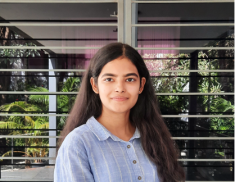
Garima Ahuja pursuing Ph.D.
Education: Garima obtained Bachelors degree in Physics (Honours) from Sri Venkateswara College (University of Delhi) with the highest grade and institute medal. She obtained Masters in Physics from the prestigious St. Stephen's College, University of Delhi. She joined the group at JNCASR in August 2022 for pursuing a PhD.
Brief Overview of Research: Her work focuses on understanding and engineering material properties for quantum technologies, with emphasis on semiconductor interfaces for electron and hole qubit architectures. She employs first-principles approaches to study the formation of 2D electron and hole gases for such applications. This project is in collaboration with the Quantum Information Theory group of Prof. Anil Shaji at IISER Tvm, India.
Working in collaboration with the group of Prof. Dr. Stefan Blügel in Germany, she is involved in investigating magnetic response, as well as spin and orbital effects in materials. She also contributes to the development and implementation of computational frameworks for such studies, including Wannier-based approaches.
She is keen to further explore the diverse and fascinating field of materials science. Beyond her research, she has a strong interest in art, travel, and science communication.
Email: garima@jncasr.ac.in
g.ahuja@extern.fz-juelich.de
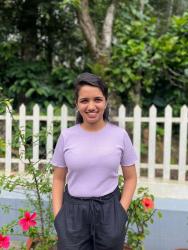
Tanuja Shridhar Joshi pursuing Ph.D.
Education: Tanuja received her primary education from Canara High School, Mangalore, Karnataka. She completed her BSc in Physics, Chemistry, and Mathematics (PCM) from St. Aloysius College and went on to pursue her MSc in Physics from National Institute of Technology, Karnataka.
Tanuja joined the Computational Nanoscience group at JNCASR for pursuing PhD in August 2023.Research interests:
Tanuja is interested in using machine learning (ML) techniques to expedite materials discovery and efficiently design novel materials. She is now starting to look for ways of leveraging ML techniques in the domain of Spin-Crossover systems.
Beyond her research pursuits, she has a deep appreciation for Indian classical music. She also likes to read, especially novels, in her free time.
Email ID: tsjoshi2k[at]hotmail[dot]com, tanujasj[at]jncasr[dot]ac[dot]in
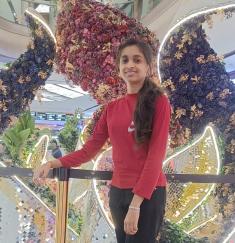
Rubee Swarnkar pursuing Ph.D.
Education: Rubee did her schooIing from Dhamdha, Chhattishgarh. She completed B.Sc. in PCM form Chandulal Chandrakar Arts And Science College (Durg University) and Masters in Physics from Guru Ghasidas Central University Bilaspur Chhattishgarh.
Rubee joined the Computational Nanoscience group at JNCASR for pursuing PhD in January 2024.
Research interests:
Rubee is currently working on finding aromatic stabilization energy of different organic molecules. Besides academics, she likes cooking, listening music and solving crossword puzzles.
Email ID: rubee[at]jncasr[dot]ac[dot]in
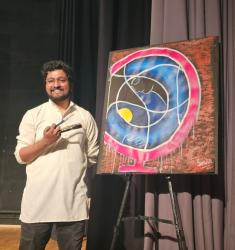
Sarwin Deon Chandran pursuing Ph.D.
Education: Sarwin did his schooling in St Aloysius Institutions, Mangalore, Karnataka. He obtained his B.Sc. Triple Major in Physics, Computer Science, and Mathematics from St Aloysius (Deemed to be University) in 2022. He then did his M.Sc in Physics from NITK Surathkal in 2024.
Sarwin joined the Computational Nanoscience Group, JNCASR, for pursuing his PhD in August, 2024.
Research Area: His work focuses mainly on the study of 2D Materials and the interesting properties that come about from them due to the reduction in dimensionality.
Study of Defects in Twisted Bilayer Transition Metal Dichalcogenides: Sarwin uses Density Functional Theory DFT based calculations and Machine Learning Interatomic Potentials (MLI to study the site references of defects in tbTMDs in collaboration with the exerimental group of Dr Medha Dandu in CPMU, JNCASR. His broader aim is to study the effect of vacancy defects on the Moiré potentials and the excitonic properties of these twisted TMDs.
Along with using existing machinery in his research, he is actively developing some software packages himself. A few are as follows
CELLSTINE: CELL Superlattice Transformation INterface and Engine is an under-development Python package and guided command-line tool for building atomistic structures used in VASP-style materials workflows. It provides grouped workflows for commensurate moire supercells, molecule-on-substrate placement, surface generation, adsorption-site analysis, slab-on-slab interface construction, defect-structure generation, and direct symmetry analysis. Link - https://github.com/sarwin89/cellstine
Apart from academics, Sarwin's interests are in Painting, playing the guitar, reading historical fiction, watching anime, creating Kirigami art, cooking, creating simulations and more. You can find o
AutoSlurm: A bash-based iterative job submission script for VASP on slurm.
Email: sarwin@jncasr.ac.in
sarwindeon@gmail.com or sarwindeon@outlook.com
- Back to previous page
- |
-
Page last updated date:09-06-2026 05:48 PM